
Kidney stones can be extremely painful, often causing waves of discomfort. If you or someone you know has been diagnosed with kidney stones, it’s essential to understand the best treatment options. The two most common and least invasive procedures available today are Shockwave Lithotripsy (SWL) and Ureteroscopy with Laser Lithotripsy.
Both treatments aim to break the stone into smaller pieces, making it easier for it to pass through the body. However, they work differently, and each has its own advantages and disadvantages. By understanding these differences, you can feel more confident and informed about your care.
In this discussion, we will explore “Shockwave Lithotripsy vs. Laser Treatment for Kidney Stones: Pros and Cons.” Let’s break this down in a clear, friendly, and practical way.
Shockwave Lithotripsy (SWL) is a medical procedure that uses high-energy sound waves to break up kidney stones. This technique delivers sound waves from outside the body to target the stones, without requiring any incisions. The machine sends shockwaves through the skin to the stones, which then break into smaller pieces that can be expelled naturally through urine.
SWL has been available for several decades and remains widely used today due to its speed, non-invasive nature, and typically outpatient performance.
Let’s break it down in a clear, approachable, and actionable way.
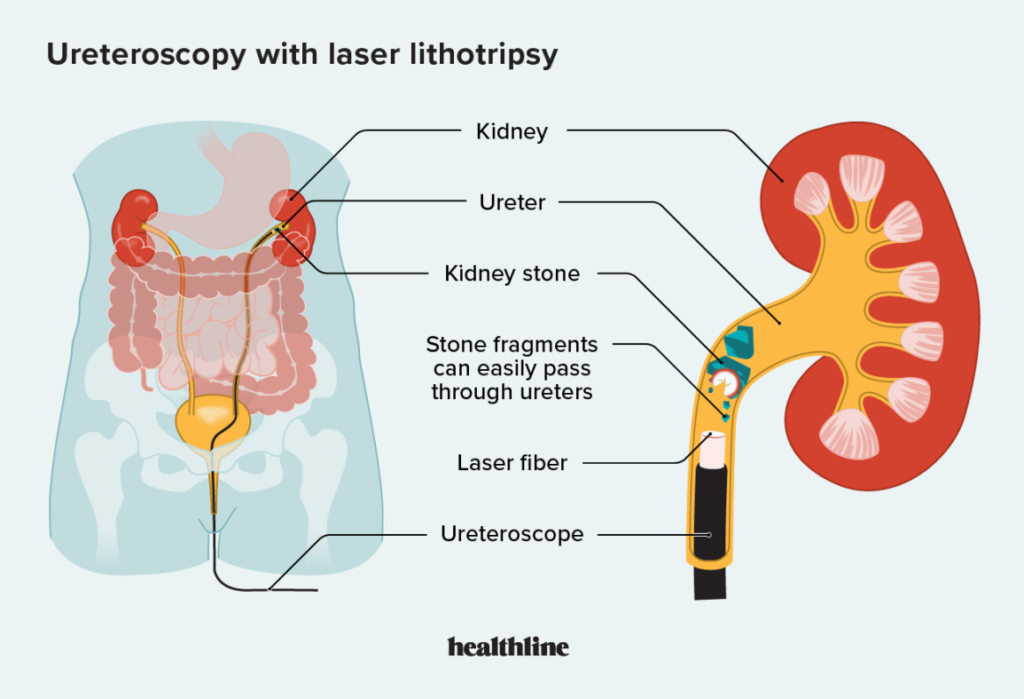
In laser treatment, the surgeon passes a narrow, flexible ureteroscope through the urethra and bladder into the ureter or kidney. When found, the stone is crushed with a high-energy laser, such as a Holmium or Thulium fiber laser.
This minimally invasive technique allows the physician to clearly see and treat the stone with extreme accuracy. It is particularly effective for harder, larger, or more difficult-to-reach stones.
According to the National Institutes of Health, “In the group randomised to shockwave lithotripsy, 67/302 (22.2%) were retreated compared with 31/302 (10.3%) in those receiving ureteroscopic stone treatment, a difference of 11.4% (95% confidence interval 5.0% to 17.8%). The average quality-adjusted life-year difference was -0.021 (95% CI: -0.033 to 0.010), and SWL has a probability of 79% of being cost-effective.
Below is a straightforward and helpful side-by-side comparison of the two alternatives:
Pros of Shockwave Lithotripsy:
Cons of Shockwave Lithotripsy:
Pros/Benefits of Laser Treatment are mentioned below:
Cons of Laser Treatment:
Laser treatment is excellent for complex or challenging stones, and it’s a good option for patients who want a more definitive (one-and-done) type of therapy.
The straight answer: It depends on the type of stone and your health.
SWL might be best if:
Laser Treatment may be ideal if:
Think of SWL as the easier, gentler, and less invasive treatment, and laser treatment as more powerful and precise.
After Shockwave Lithotripsy: You may expect:
After Laser Treatment: You can expect:
Generally:
It all depends on your insurance, but both are usually covered because they are medically necessary for kidney stone treatment.
Quick Comparison of ShockWave Lithotripsy and Laser Treatment for Kidney Stones:
| Feature / Factor | Shockwave Lithotripsy (SWL) | Laser Treatment (Ureteroscopy w/ Laser) |
| Invasiveness | Non-invasive (external shockwaves) | Minimally invasive (scope through urinary tract) |
| Effectiveness | Best for small–medium stones | Highly effective for stones of all sizes, including very hard stones |
| Anesthesia | Usually sedation or light anesthesia | General anesthesia |
| Recovery Time | Short; often back to normal in 1–2 days | Slightly longer; mild soreness for a few days |
| Stone Location | Ideal for kidney/lower ureter stones | Works for stones anywhere (kidney, ureter, multiple stones) |
| Success Rate | Moderate; may require repeat sessions | Very high; usually a one-time procedure |
| Best For | Softer stones, patients avoiding invasive treatment | Larger, harder, or multiple stones; complex cases |
| Risks | Residual fragments, bruising, incomplete breakage | Temporary stent discomfort, mild bleeding |
When you’re suffering from kidney stones and seeking a reliable treatment, you need a specialist who offers expertise, leading-edge technology, and personalized attention. Dr. Mourad Abouelleil, based in West Palm Beach, has significant experience in diagnosing and managing all types of kidney stones, employing the most modern and safest procedures — including Shockwave Lithotripsy and state-of-the-art laser lithotripsy. His approach is thorough and patient-centered: he educates his patients about their stone type, covers all treatment options, and offers the best solution for each patient. When you choose Dr. Abouelleil, you will receive skilled hands, clear guidance, and compassionate care from consultation through postoperative healing.
Question. Is shockwave lithotripsy less painful than a laser treatment?
Answer. SWL typically feels softer because it’s noninvasive, although you may experience pressure during treatment and pain when passing fragments. Laser treatment is done under anesthesia, so you’re not going to experience the treatment itself, but some mild discomfort or pain may persist.
Question. Can you get kidney stones again after treatment?
Answer. Yes, unfortunately, stones can recur, whether you have energy or lithotripsy. That’s why prevention, through proper hydration, dietary changes, and, sometimes, medication, is key. Your doctor can follow up to identify why your stones formed and develop a longer-term plan for prevention.
Question. Is laser treatment safe for large kidney stones?
Answer. Absolutely. Laser lithotripsy is one of the best procedures for large, hard, or complex stones. The doctor can visualize the stone directly and reduce it to very fine fragments, making the passage and removal of the stone much easier.
Question. What is the recovery time for shockwave lithotripsy?
Answer. SWL recovery is often speedy — a lot of people feel back to normal the next day. There could be a couple of days of soreness or some stent discomfort after laser surgery, but again, the patients tend to make a rapid recovery.
Question. How do I figure out which procedure is best for me?
Answer. You can consult your doctor, who will consider the size, hardness, and location of your stones, as well as your overall health. SWL is an effective option for patients with simple stones, whereas a laser is ideal for those with larger stones. A consultation can also help clarify which will fit you best.

Dr. Mourad Abouelleil is a highly skilled and certified urologist renowned for his commitment to excellence in advanced urological procedures, including robotic prostatectomy and high-intensity focused ultrasound (HIFU). With state-of-the-art technology and extensive experience, Dr. Abouelleil offers personalized treatment plans tailored to meet the unique needs of each patient, ensuring high-quality medical care.
Error: Contact form not found.