
Urolift vs Rezum: The Better Minimally-Invasive BPH Option in 2025
Benign Prostatic Hyperplasia (BPH) affects millions of men worldwide, often leading to frustrating urinary symptoms that impact daily life and sleep. While medications can help, many men seek long-term minimally invasive solutions without the downtime and associated risks of traditional surgery.
According to UroToday, in a head-to-head observational study comparing two MITs, the AUA symptom score improved by 50.3% with Rezum and 44.5% with Urolift.
Two of the most popular options in 2025 are Urolift and Rezum. Both procedures are designed to relieve symptoms, preserve sexual function, and improve quality of life – but which one is right for you? This article breaks down everything you need to know, including procedure details, recovery, side effects, and real-world outcomes.
Benign Prostatic Hyperplasia, or BPH, is a non-cancerous enlargement of the prostate gland, common in men over 50. As the prostate grows, it can compress the urethra, causing urinary symptoms such as:
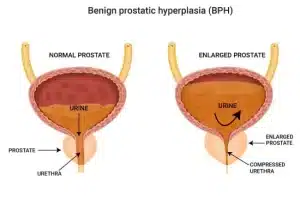
Traditional treatments like medication or transurethral resection of the prostate (TURP) can be effective but may carry risks, including sexual side effects or a lengthy recovery. Minimally invasive procedures like UroLift and Rezūm provide alternatives with less downtime and fewer complications.
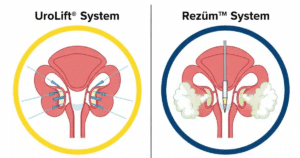
UroLift is a minimally invasive procedure designed to mechanically lift and hold enlarged prostate tissue away from the urethra, relieving obstruction without removing tissue.
Key Features:
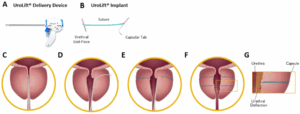
How it works: Tiny implants are placed in the prostate to “lift” obstructing tissue, allowing urine to flow more freely. Unlike traditional surgery, there’s no cutting or removal of tissue.
Side Effects: Temporary urinary discomfort, mild blood in urine, urgency, or pelvic pain. Most resolve within a few days to a week.
Studies continue to show that UroLift offers durable symptom relief for up to 5 years, with high patient satisfaction and low retreatment rates.
Rezūm uses water vapor therapy (steam) to ablate excess prostate tissue. The heat destroys targeted cells, shrinking the prostate over time and relieving urethral pressure.
Key Features:
How it works: A small device delivers controlled steam directly into the prostate, targeting enlarged tissue while sparing surrounding structures. The body naturally absorbs the treated tissue over time.
Side Effects: Temporary urgency, frequency, discomfort during urination, and mild blood in urine.
Clinical Insight (2025): Rezūm is highly effective for mild to moderate BPH, and ongoing studies confirm durability for 4–5 years with low risk of sexual dysfunction.
| Feature | UroLift | Rezūm |
| Procedure Type | Mechanical implants | Steam ablation |
| Anesthesia | Local or general | Local or general |
| Recovery | 1–3 days | 1–2 weeks for urinary symptoms |
| Symptom Relief | Immediate to a few days | Gradual, weeks to months |
| Durability | 5+ years | 4–5 years |
| Sexual Function | Preserved | Usually preserved |
| Ideal Candidates | Moderate BPH, smaller prostates | Mild to moderate BPH, larger prostates may benefit |
| Side Effects | Mild, temporary urinary discomfort | Temporary urinary urgency/frequency |
Choosing the right minimally invasive BPH treatment depends on several factors:

A urologist like Dr. Abouelleil can provide a personalized recommendation based on your medical history, prostate anatomy, and lifestyle goals.
UroLift: Patients often report immediate symptom relief, improved urinary flow, and minimal downtime. Satisfaction rates remain high after 5 years.
Rezūm: Patients may notice gradual improvement over weeks, but benefits are durable, and retreatment rates are low.
Both procedures significantly improve the quality of life, reduce nocturia, and allow patients to avoid major surgery.
Both UroLift and Rezūm are safe, minimally invasive, and effective options for men seeking relief from BPH symptoms in 2025.
UroLift: Best for rapid relief, small to moderate prostates, minimal downtime.
Rezūm: Suitable for mild to moderate BPH, slightly larger prostates, and gradual improvement.
The best choice depends on your prostate size, symptom severity, recovery preferences, and lifestyle considerations. Speak with a certified urologist, such as Dr. Mourad Abouelleil, to determine whether UroLift or Rezūm is the right minimally invasive BPH solution for you.
Schedule a consultation today to explore your options.
Answer. Typically around 1 hour, performed as an outpatient procedure.
Answer. Improvement is gradual, usually within 2–6 weeks, with full effect over a few months.
Answer. Yes. Both can be repeated or followed by other treatments if necessary.
Answer. Long-term complications are rare. Most side effects are temporary urinary discomfort.
Answer. Coverage varies by provider and region; most major insurers cover minimally invasive BPH procedures, but confirmation is recommended.

Dr. Mourad Abouelleil is a highly skilled and certified urologist renowned for his commitment to excellence in advanced urological procedures, including robotic prostatectomy and high-intensity focused ultrasound (HIFU). With state-of-the-art technology and extensive experience, Dr. Abouelleil offers personalized treatment plans tailored to meet the unique needs of each patient, ensuring high-quality medical care.
Error: Contact form not found.